The Reset
Understanding the emerging financial system
“The reset” is shorthand for a structural reconfiguration of money and finance that is already underway. It is being built around four converging technologies that, together, could change how value is stored, moved, and permitted. This page is a calm, plain-English map of what is being built and what it could mean — for the economy, for personal finances, and for society. It is not a prediction of doom, and it is not a sales pitch. It is a research-grounded orientation, written to be understood by experts and non-experts alike.
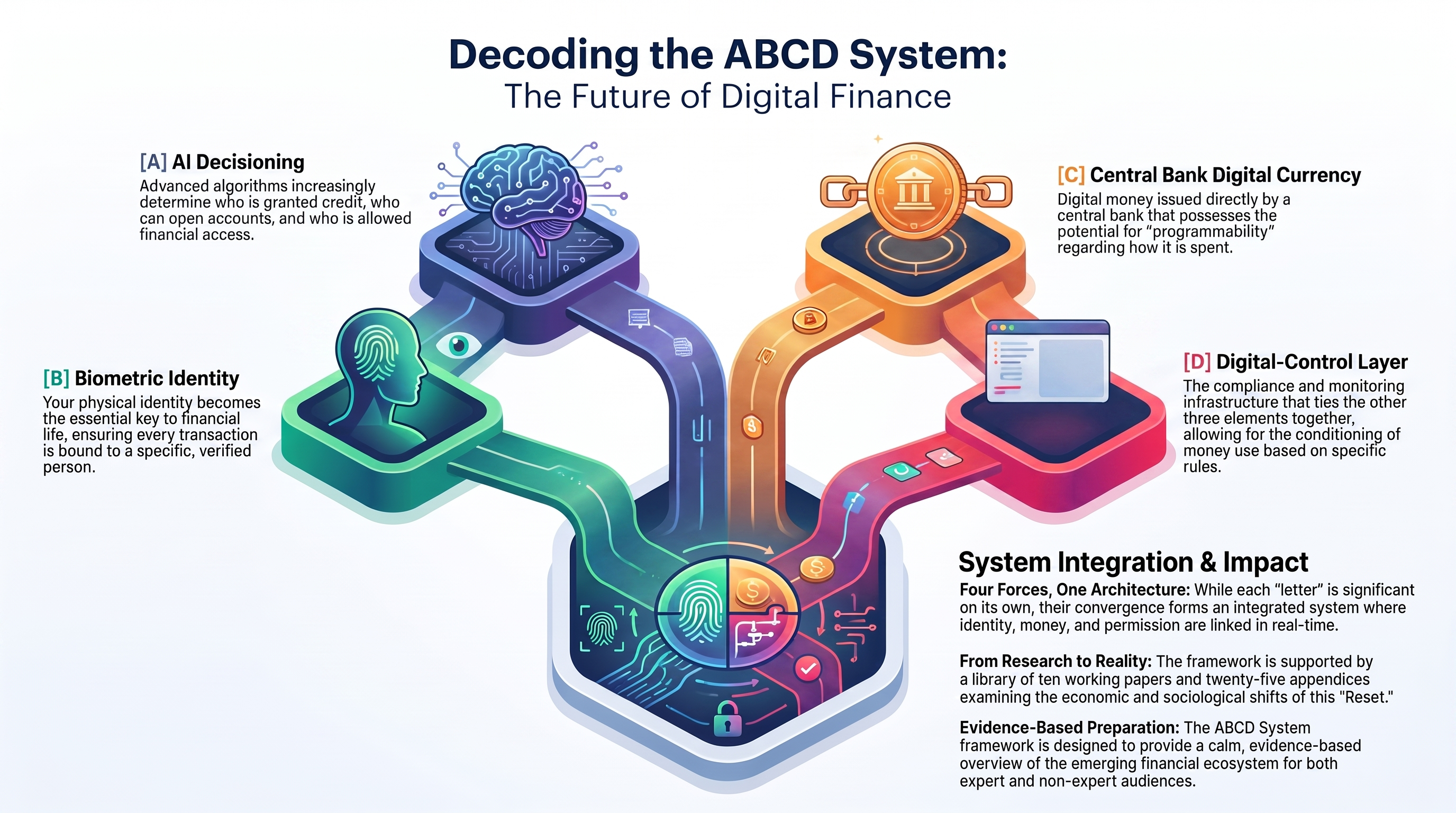
The ABCD System: four pillars, one architecture
Most of the change can be organized under four letters — the “ABCD System.” Each pillar is meaningful on its own; the significance comes from how they reinforce one another when combined into a single, integrated architecture.
Artificial-intelligence decisioning
Algorithms increasingly track, trace, and permit economic activity such as who receives credit, who can open or keep an account, and who is flagged for review — shifting judgment from people to models.
Biometric identification
Your identity — face, fingerprint, iris, and more — becomes the key to financial life and society itself; only opening doors that the system allows.
Central bank digital currencies
Digital forms of money issues directly by a central bank or authorized private entity. Unlike the cash in your pocket, it can be fully tracked, traced, programmed, and even controlled.
The digital-control layer
The compliance, monitoring, and rules layer that ties the other three together — the machinery that can observe activity and condition what money is allowed to do.
Individually, these technologies are somewhat limited tools. Combined, they form something entirely new: a financial architecture or system in which identity, money, and permission can be linked in real time. This linkage is the heart of what our research examines.
Why it is happening
The build-out is not driven by a single motive. Proponents point to real goals: lower costs and faster payments, broader financial inclusion, reduced fraud and financial crime, sharper tools for monetary policy, and — increasingly — geopolitical competition, as nations race to set the standards others will adopt. The same design choices that deliver those benefits, however, also concentrate capability. Our work takes the stated goals seriously while examining, soberly, what the resulting capability makes possible.
What could change — the economic effects
Automation and artificial intelligence are expected to displace a meaningful share of paid work. One widely discussed response is a universal basic income or dividend — a regular payment delivered, plausibly, through the new digital rails. That combination matters: when income arrives as programmable money, the same channel that pays people can also attach conditions to how the money is spent. The result is a potential shift in where economic power sits — toward whoever designs and administers the financial rails.
What could change — the financial effects
For most of modern history, a financial system performed roughly seven roles — storing and moving value, facilitating transactions, assisting investment, pooling savings and extending credit, pricing and managing risk, price discovery, and economic distribution. The emerging system adds new roles: programmability (money that can carry rules), identity-anchoring (value bound to a verified person), surveillance (activity that can be observed by design), and value-conditioning (permissions that can vary by context). Two consequences follow. First, the risk of exclusion rises — being "de-banked" or "gated out" becomes a more powerful behavioral and social lever. Second, the financial system may bifurcate or split in two with a digital mainstream system co-existing alongside parallel financial systems used by those who cannot, or choose not, to participate fully.
What could change — the sociological effects
A change in the financial system this consequential does not meet a single, uniform public. Our research consistently finds four populations forming in response, and much of the human story lies in how people move among them:
The Participating Majority
Those who, to varying degrees of willingness, adopt the system and organize their lives within it.
The Embedded Remnant
Those who stay inside the system yet quietly sustain a different set of values, beliefs, and community.
The Disenchanted Dissenters
Former system enthusiasts who grow uneasy and begin to exit toward parallel arrangements.
The Resistant Remnant
Those who decline participation from the outset, on practical or ethical grounds, and build alternatives.
Around these populations cluster enduring questions of privacy, liberty, faith, belonging, and how communities form and stay cohesive — or remain discoverable — in a more transparent world.
How to think about it — our posture
Reset Ready Labs is a research and education effort. Our stance is deliberate: measured, evidence-based, and non-alarmist. We think the useful response to a period of significant change is understanding first, and then lawful preparation — building resilience and prudent diversification rather than acting from fear. We draw a clear line between lawful non-participation, which is simply a choice, and evasion of any legal obligation, which we do not counsel. Nothing here is investment, legal, or tax advice; it is education and analysis intended to help you think clearly and prepare wisely.
The Reset in every format — media & downloads
The overview above is also available as a branded executive summary, an infographic, two slide decks, and four companion videos. Explore or download whichever format is most useful.
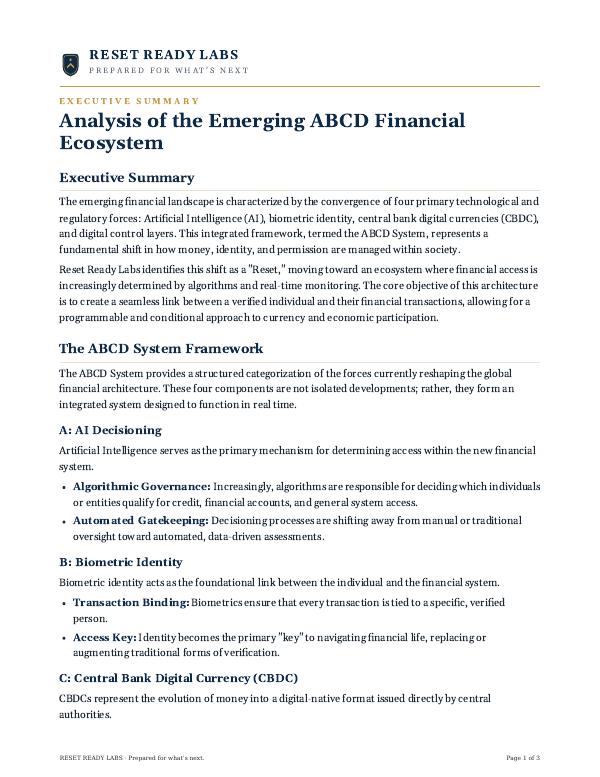
Executive Summary
A branded analysis of the emerging ABCD financial ecosystem.
Infographic
The ABCD System at a glance. Click to enlarge.
Slide Decks
The first slide of each deck; open the full presentation as a PDF.
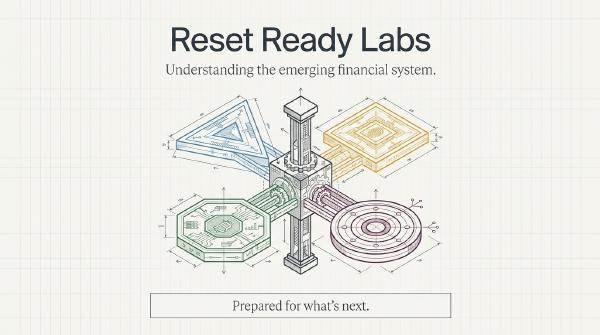
Video
Four companion videos — a short, an explainer, a cinematic piece, and a podcast. Play them here, or open them on VideoPress.
Short-form video
Watch on VideoPress ↗
Explainer video
Watch on VideoPress ↗
Cinematic film
Watch on VideoPress ↗